14  多个模型筛选的工作流集合

Section 10.1 中演示了如何将workflowset对象与重抽样数据集结合使用。当时只是一个简单的应用,本章将详细讨论wokflowset的使用方法。

本章我们使用混泥土抗压强度数据集concreteworkflowset的使用过程进行演示。

14.1 数据载入和划分

Rows: 1,030
Columns: 9
$ cement               <dbl> 540.0, 540.0, 332.5, 332.5, 198.6, 266.0, 380.0, …
$ blast_furnace_slag   <dbl> 0.0, 0.0, 142.5, 142.5, 132.4, 114.0, 95.0, 95.0,…
$ fly_ash              <dbl> 0, 0, 0, 0, 0, 0, 0, 0, 0, 0, 0, 0, 0, 0, 0, 0, 0…
$ water                <dbl> 162, 162, 228, 228, 192, 228, 228, 228, 228, 228,…
$ superplasticizer     <dbl> 2.5, 2.5, 0.0, 0.0, 0.0, 0.0, 0.0, 0.0, 0.0, 0.0,…
$ coarse_aggregate     <dbl> 1040.0, 1055.0, 932.0, 932.0, 978.4, 932.0, 932.0…
$ fine_aggregate       <dbl> 676.0, 676.0, 594.0, 594.0, 825.5, 670.0, 594.0, …
$ age                  <int> 28, 28, 270, 365, 360, 90, 365, 28, 28, 28, 90, 2…
$ compressive_strength <dbl> 79.99, 61.89, 40.27, 41.05, 44.30, 47.03, 43.70, …
数据集包含9个变量,其中compressive_strength是响应变量,其余的为预测变量:

  • age的单位为天数,表示混泥土样品的存放时间,混凝土的强度随时间的增加而增强。
  • cementwater等表示水泥的组成成分,单位为\(kg/m^3\)
  • 该数据中有一些重复的混凝土配方(即相同的成分组合),它们可能会在训练集和测试集中同时出现,导致数据泄漏,从而导致我们对模型过分乐观的评估。为了避免这种情况,我们使用每种混凝土的平均抗压强度作为响应变量进行建模。
concrete <- concrete %>%
  group_by(across(-compressive_strength)) %>%
  summarise(
    compressive_strength = mean(compressive_strength),
    .groups = "drop"
  )

# data split
set.seed(1501)
concrete_split <- initial_split(concrete, strata = compressive_strength)
contrete_train <- training(concrete_split)
contrete_test <- testing(concrete_split)

# resample
set.seed(1502)
concrete_folds <- vfold_cv(
  contrete_train,
  strata = compressive_strength,
  v = 10, repeats = 5
)

14.2 建立模型

14.2.1 建立recipe

某些模型(如神经网络,KNN,SVM等)需要对预测变量进行标准化和中心化处理,其他模型则不需要,因此我们创建两个不同的recipe对象。

normalized_recipe <-
  recipe(compressive_strength ~ ., data = contrete_train) %>%
  step_normalize(all_predictors())

poly_recipe <-
  recipe(compressive_strength ~ ., data = contrete_train) %>%
  step_poly(all_predictors()) %>% # 建立正交多项式(二次项)
  step_interact(~ all_predictors():all_predictors()) # 交互项目

14.2.2 建立模型-parsnip及其扩展包

library(rules) # 关联规则挖掘和规则模型构建
library(baguette) # 自助聚合算法包

linear_reg_spec <-
  linear_reg(penalty = tune(), mixture = tune()) %>%
  set_mode("regression") %>%
  set_engine("glmnet")

nnet_spec <-
  mlp(hidden_units = tune(), epochs = tune(), penalty = tune()) %>%
  set_mode("regression") %>%
  set_engine("nnet", MaxNWts = 2600)

mars_spec <-
  mars(prod_degree = tune()) %>%
  set_engine("earth") %>%
  set_mode("regression")

svm_r_spec <-
  svm_rbf(cost = tune(), rbf_sigma = tune()) %>%
  set_engine("kernlab") %>%
  set_mode("regression")

svm_p_spec <-
  svm_poly(cost = tune(), degree = tune()) %>%
  set_engine("kernlab") %>%
  set_mode("regression")

knn_spec <-
  nearest_neighbor(
    neighbors = tune(),
    dist_power = tune(),
    weight_func = tune()
  ) %>%
  set_engine("kknn") %>%
  set_mode("regression")

cart_spec <-
  decision_tree(cost_complexity = tune(), min_n = tune()) %>%
  set_engine("rpart") %>%
  set_mode("regression")

bag_cart_spec <-
  bag_tree() %>%
  set_engine("rpart", times = 50L) %>%
  set_mode("regression")

rf_spec <-
  rand_forest(trees = tune(), min_n = tune(), mtry = tune()) %>%
  set_engine("ranger") %>%
  set_mode("regression")

xgb_spec <-
  boost_tree(
    tree_depth = tune(), learn_rate = tune(),
    loss_reduction = tune(), min_n = tune(),
    sample_size = tune(), trees = tune()
  ) %>%
  set_engine("xgboost") %>%
  set_mode("regression")

cubist_spec <-
  cubist_rules(committees = tune(), neighbors = tune()) %>%
  set_engine("Cubist") %>%
  set_mode("regression")

# 修改神经网络模型的默认参数范围,根据前人的分析结果
nnet_param <-
  nnet_spec %>%
  extract_parameter_set_dials() %>%
  update(hidden_units = hidden_units(c(1, 27)))

14.3 建立workflowset

workflowset对象包含两个列表:

  • 不同模型设定组成的models列表。
  • 不同预处理步骤组成的preproc列表,包括公式、recipe对象或用于选择变量的dplyr风格选择器。
  • 可以通过wflow_id对每个工作流进行提取。
  • option列是占位符,当对工作流进行评估时可添加任何参数。
  • result列是占位符,存放调优函数或重抽样函数的输出结果。
normalized <-
  workflow_set(
    preproc = list(normalized = normalized_recipe),
    models = list(
      SVM_radial = svm_r_spec,
      SVM_poly = svm_p_spec,
      KNN = knn_spec,
      neural_network = nnet_spec
    )
  )

# 添加神经网络模型的超参数对象修改,使用tune或finetune时会用到
normalized <-  
  normalized %>% 
  option_add(param_info = nnet_param, id = "normalized_neural_network")

normalized
# A workflow set/tibble: 4 × 4
  wflow_id                  info             option    result    
  <chr>                     <list>           <list>    <list>    
1 normalized_SVM_radial     <tibble [1 × 4]> <opts[0]> <list [0]>
2 normalized_SVM_poly       <tibble [1 × 4]> <opts[0]> <list [0]>
3 normalized_KNN            <tibble [1 × 4]> <opts[0]> <list [0]>
4 normalized_neural_network <tibble [1 × 4]> <opts[1]> <list [0]>
model_vars <- workflow_variables(
  outcomes = compressive_strength,
  predictors = everything()
)

no_pre_proc <- 
  workflow_set(
    preproc = list(simple = model_vars),
    models = list(
      MARS = mars_spec,
      CART = cart_spec,
      CATR_bagged = bag_cart_spec,
      RF = rf_spec,
      boosting = xgb_spec,
      Cubist = cubist_spec
    )
  )
no_pre_proc
# A workflow set/tibble: 6 × 4
  wflow_id           info             option    result    
  <chr>              <list>           <list>    <list>    
1 simple_MARS        <tibble [1 × 4]> <opts[0]> <list [0]>
2 simple_CART        <tibble [1 × 4]> <opts[0]> <list [0]>
3 simple_CATR_bagged <tibble [1 × 4]> <opts[0]> <list [0]>
4 simple_RF          <tibble [1 × 4]> <opts[0]> <list [0]>
5 simple_boosting    <tibble [1 × 4]> <opts[0]> <list [0]>
6 simple_Cubist      <tibble [1 × 4]> <opts[0]> <list [0]>
with_features <- 
  workflow_set(
    preproc = list(full_quad = poly_recipe),
    models = list(linear_reg = linear_reg_spec,
                  KNN = knn_spec)
  )
with_features
# A workflow set/tibble: 2 × 4
  wflow_id             info             option    result    
  <chr>                <list>           <list>    <list>    
1 full_quad_linear_reg <tibble [1 × 4]> <opts[0]> <list [0]>
2 full_quad_KNN        <tibble [1 × 4]> <opts[0]> <list [0]>

所有的输出对象都是tibble格式,并且包含一个额外的workflow_set类。可以进行行连接整合所有工作流集合。

可以通过class()函数查看
all_workflow <- 
  bind_rows(no_pre_proc, normalized, with_features) %>% 
  # 简化wflow_id
  mutate(wflow_id = gsub("(simple_)|(normalized_)", "", wflow_id))
all_workflow
# A workflow set/tibble: 12 × 4
   wflow_id             info             option    result    
   <chr>                <list>           <list>    <list>    
 1 MARS                 <tibble [1 × 4]> <opts[0]> <list [0]>
 2 CART                 <tibble [1 × 4]> <opts[0]> <list [0]>
 3 CATR_bagged          <tibble [1 × 4]> <opts[0]> <list [0]>
 4 RF                   <tibble [1 × 4]> <opts[0]> <list [0]>
 5 boosting             <tibble [1 × 4]> <opts[0]> <list [0]>
 6 Cubist               <tibble [1 × 4]> <opts[0]> <list [0]>
 7 SVM_radial           <tibble [1 × 4]> <opts[0]> <list [0]>
 8 SVM_poly             <tibble [1 × 4]> <opts[0]> <list [0]>
 9 KNN                  <tibble [1 × 4]> <opts[0]> <list [0]>
10 neural_network       <tibble [1 × 4]> <opts[1]> <list [0]>
11 full_quad_linear_reg <tibble [1 × 4]> <opts[0]> <list [0]>
12 full_quad_KNN        <tibble [1 × 4]> <opts[0]> <list [0]>

14.4 调优并评估模型

  • 几乎所有的all_workflow成员都包括超参数。
  • workflow_map()函数可以将调优函数或重抽样函数应用到workflow_set()中的所有单个workflow中(默认使用tune_grid()),不用单独调用tune_grid()等函数。
# 设定并行计算选项
library(doParallel)
library(finetune)
registerDoParallel(core = round(parallel::detectCores() * 0.8))
# 创建规则网格,大小为25
## 指定grid控制选项
race_ctrl <- 
  control_race(
    save_pred = TRUE,
    parallel_over = "everything",
    save_workflow = TRUE,
    verbose = TRUE
  )

## 网格搜索-竞争法
race_results <- 
  all_workflow %>% 
  workflow_map(
    "tune_race_anova",
    seed = 1503,
    resamples = concrete_folds,
    grid = 25,
    control = race_ctrl
  )
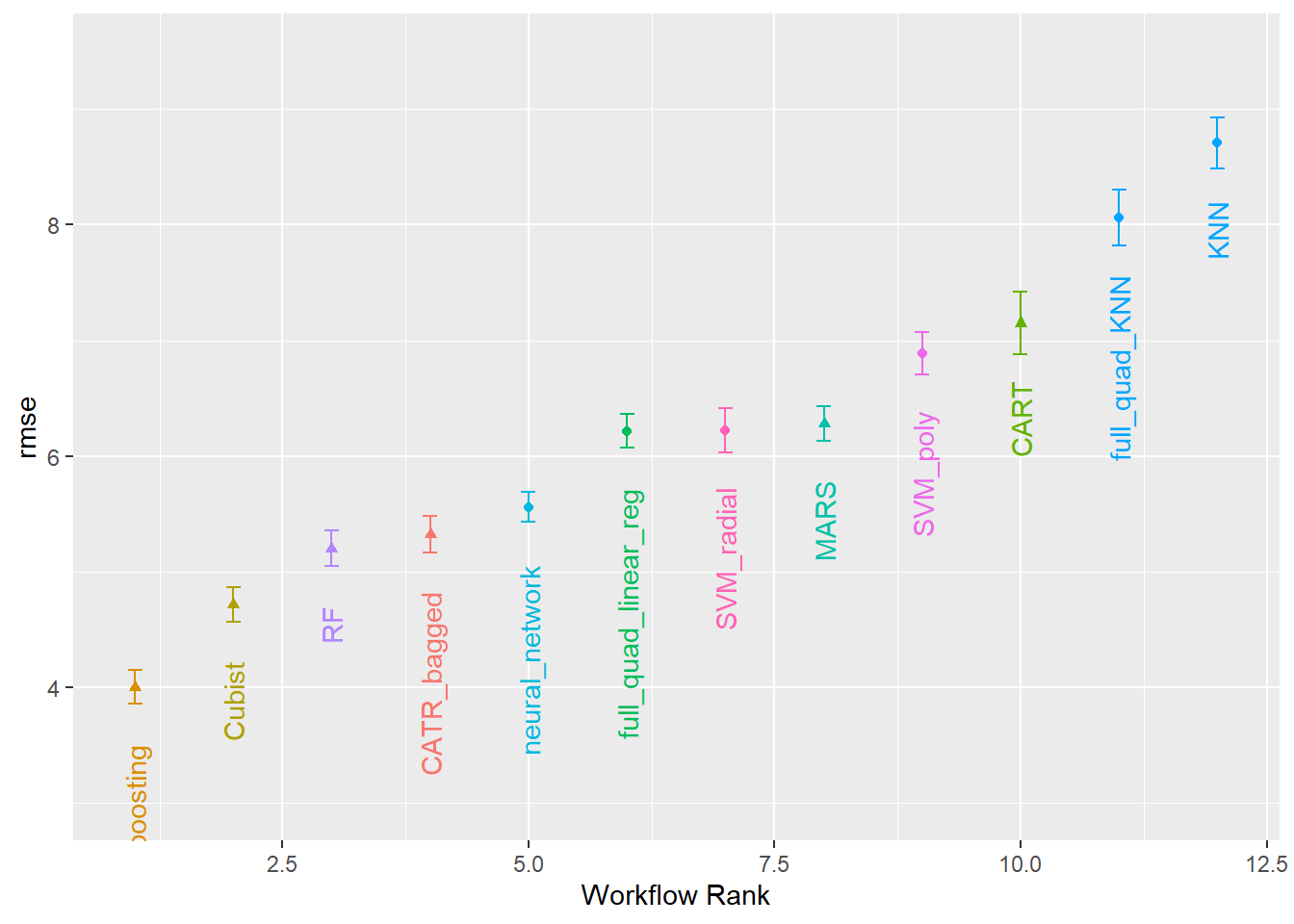
race_results %>% 
  collect_metrics() %>% 
  filter(.metric == "rmse") %>% 
  arrange(mean)
# A tibble: 12 × 9
   wflow_id         .config preproc model .metric .estimator  mean     n std_err
   <chr>            <chr>   <chr>   <chr> <chr>   <chr>      <dbl> <int>   <dbl>
 1 boosting         pre0_m… workfl… boos… rmse    standard    4.00    50  0.0889
 2 Cubist           pre0_m… workfl… cubi… rmse    standard    4.71    50  0.0913
 3 RF               pre0_m… workfl… rand… rmse    standard    5.20    50  0.0929
 4 CATR_bagged      pre0_m… workfl… bag_… rmse    standard    5.32    50  0.0968
 5 neural_network   pre0_m… recipe  mlp   rmse    standard    5.56    50  0.0778
 6 full_quad_linea… pre0_m… recipe  line… rmse    standard    6.22    50  0.0867
 7 SVM_radial       pre0_m… recipe  svm_… rmse    standard    6.22    50  0.114 
 8 MARS             pre0_m… workfl… mars  rmse    standard    6.28    50  0.0897
 9 SVM_poly         pre0_m… recipe  svm_… rmse    standard    6.89    50  0.111 
10 CART             pre0_m… workfl… deci… rmse    standard    7.15    50  0.165 
11 full_quad_KNN    pre0_m… recipe  near… rmse    standard    8.06    50  0.148 
12 KNN              pre0_m… recipe  near… rmse    standard    8.71    50  0.136 
# 探索网格搜索结果
autoplot(
  race_results,
  rank_metric = "rmse",
  metric = "rmse",
  select_best = TRUE
) +
  geom_text(
    # mean为collect_metrics(race_results)的结果
    aes(y = mean - 1/2, label = wflow_id), 
    angle = 90, hjust = 1
  ) +
  lims(y = c(3.0, 9.5)) +
  theme(legend.position = "none")

collect_metrics(race_results)
# A tibble: 24 × 9
   wflow_id    .config      preproc model .metric .estimator  mean     n std_err
   <chr>       <chr>        <chr>   <chr> <chr>   <chr>      <dbl> <int>   <dbl>
 1 MARS        pre0_mod1_p… workfl… mars  rmse    standard   6.28     50 0.0897 
 2 MARS        pre0_mod1_p… workfl… mars  rsq     standard   0.855    50 0.00452
 3 CART        pre0_mod09_… workfl… deci… rmse    standard   7.15     50 0.165  
 4 CART        pre0_mod09_… workfl… deci… rsq     standard   0.818    50 0.00786
 5 CATR_bagged pre0_mod0_p… workfl… bag_… rmse    standard   5.32     50 0.0968 
 6 CATR_bagged pre0_mod0_p… workfl… bag_… rsq     standard   0.899    50 0.00353
 7 RF          pre0_mod18_… workfl… rand… rmse    standard   5.20     50 0.0929 
 8 RF          pre0_mod18_… workfl… rand… rsq     standard   0.904    50 0.00323
 9 boosting    pre0_mod20_… workfl… boos… rmse    standard   4.00     50 0.0889 
10 boosting    pre0_mod20_… workfl… boos… rsq     standard   0.941    50 0.00271
# ℹ 14 more rows
collect_predictions(race_results)
# A tibble: 8,916 × 7
   wflow_id .config         preproc      model  .pred compressive_strength  .row
   <chr>    <chr>           <chr>        <chr>  <dbl>                <dbl> <int>
 1 MARS     pre0_mod1_post0 workflow_va… mars  -1.77                  2.33     2
 2 MARS     pre0_mod1_post0 workflow_va… mars   1.53                  3.32     5
 3 MARS     pre0_mod1_post0 workflow_va… mars   1.48                  4.78    27
 4 MARS     pre0_mod1_post0 workflow_va… mars   4.38                  4.9     65
 5 MARS     pre0_mod1_post0 workflow_va… mars  -0.772                 6.47   112
 6 MARS     pre0_mod1_post0 workflow_va… mars   9.89                  6.81    90
 7 MARS     pre0_mod1_post0 workflow_va… mars   4.88                  6.88     6
 8 MARS     pre0_mod1_post0 workflow_va… mars  10.4                   6.9     47
 9 MARS     pre0_mod1_post0 workflow_va… mars   3.84                  6.94    56
10 MARS     pre0_mod1_post0 workflow_va… mars  13.4                   7.32    63
# ℹ 8,906 more rows

14.5 确定最终模型

  1. 提取最佳模型的workflow
  2. 根据调优结果,更新最佳模型的超参数。
  3. 拟合模型并进行后续评价或分析。
# 提取最佳模型的超参数结果
best_result <-
  race_results %>%
  extract_workflow_set_result("boosting") %>% 
  select_best(metric = "rmse")
best_result
# A tibble: 1 × 7
  trees min_n tree_depth learn_rate loss_reduction sample_size .config         
  <int> <int>      <int>      <dbl>          <dbl>       <dbl> <chr>           
1  1583     2          9     0.0365         0.0422        0.25 pre0_mod20_post0
# 更新最佳模型的超参数
boosting_test_results <- 
  race_results %>%
  extract_workflow("boosting") %>% 
  finalize_workflow(best_result) %>% 
  last_fit(concrete_split)

# 查看模型评估结果
collect_metrics(boosting_test_results)
# A tibble: 2 × 4
  .metric .estimator .estimate .config        
  <chr>   <chr>          <dbl> <chr>          
1 rmse    standard       3.45  pre0_mod0_post0
2 rsq     standard       0.953 pre0_mod0_post0
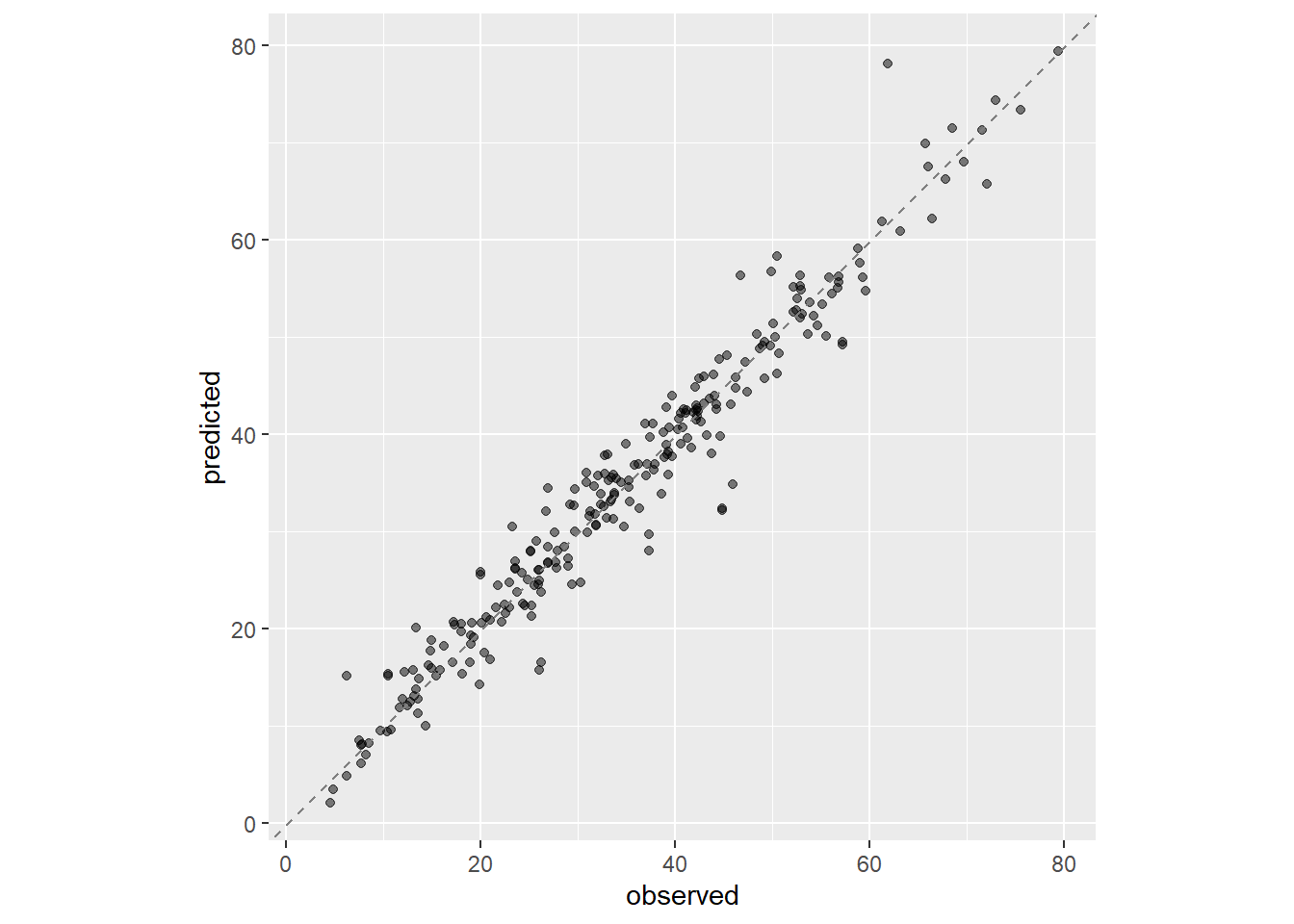
# 可视化模型预测结果
boosting_test_results %>% 
  collect_predictions() %>% 
  ggplot(aes(x = compressive_strength, y = .pred)) +
  geom_point(alpha = 0.5) +
  geom_abline(color = "gray50", lty = 2) +
  coord_obs_pred() +  # 观测值和预测值的坐标轴使用相同的scale
  labs(x = "observed", y = "predicted")

  • 结果表明,boosting模型RMSE为3.45,rsq为0.95,在测试集上的表现最好,预测值与观测值的拟合效果也很好。
  • 如果最后使用的不是workflow,而是recipemodel,可以使用finalize_recipe()finalize_model()函数得到最终的model_sepc对象,然后进行last_fit()