3 用数据讲故事
3.1 西雅图房价-案例研究1
我们将创建一个多元回归模型来预测西雅图的房价。
- 结果变量(y)为数据中的
price列。 - 预测变量(x)为数据中的
sqft_living数值列和condition分类列。分别表示房屋面积和房屋状况。
3.1.1 EDA
EDA是数据分析的第一步,目的是了解数据的基本情况和特征。
常见的EDA步骤包括:
- 查看原始数据的结构和变量信息。
- 计算描述性统计量,如均值、中位数、标准差、各种分位数等。使用
moderndive包中的tidy_summary()函数可以轻松计算这些统计量。 - 可视化数据分布和关系,如直方图、散点图、箱线图等。
- 多变量可视化,探究多个变量之间的关系。
在执行以上步骤后,根据结果可以问自己以下几个问题:
- 哪些变量是数值型的?哪些是分类型的?
- 对于分类型变量,它们的水平是什么?
- 除了我们将在回归模型中使用的变量之外,还有哪些变量在预测房价的模型中会有用?
# 查看数据基本信息
glimpse(house_prices)
Rows: 21,613
Columns: 21
$ id <chr> "7129300520", "6414100192", "5631500400", "2487200875", …
$ date <date> 2014-10-13, 2014-12-09, 2015-02-25, 2014-12-09, 2015-02…
$ price <dbl> 221900, 538000, 180000, 604000, 510000, 1225000, 257500,…
$ bedrooms <int> 3, 3, 2, 4, 3, 4, 3, 3, 3, 3, 3, 2, 3, 3, 5, 4, 3, 4, 2,…
$ bathrooms <dbl> 1.00, 2.25, 1.00, 3.00, 2.00, 4.50, 2.25, 1.50, 1.00, 2.…
$ sqft_living <int> 1180, 2570, 770, 1960, 1680, 5420, 1715, 1060, 1780, 189…
$ sqft_lot <int> 5650, 7242, 10000, 5000, 8080, 101930, 6819, 9711, 7470,…
$ floors <dbl> 1.0, 2.0, 1.0, 1.0, 1.0, 1.0, 2.0, 1.0, 1.0, 2.0, 1.0, 1…
$ waterfront <lgl> FALSE, FALSE, FALSE, FALSE, FALSE, FALSE, FALSE, FALSE, …
$ view <int> 0, 0, 0, 0, 0, 0, 0, 0, 0, 0, 0, 0, 0, 0, 0, 3, 0, 0, 0,…
$ condition <fct> 3, 3, 3, 5, 3, 3, 3, 3, 3, 3, 3, 4, 4, 4, 3, 3, 3, 4, 4,…
$ grade <fct> 7, 7, 6, 7, 8, 11, 7, 7, 7, 7, 8, 7, 7, 7, 7, 9, 7, 7, 7…
$ sqft_above <int> 1180, 2170, 770, 1050, 1680, 3890, 1715, 1060, 1050, 189…
$ sqft_basement <int> 0, 400, 0, 910, 0, 1530, 0, 0, 730, 0, 1700, 300, 0, 0, …
$ yr_built <int> 1955, 1951, 1933, 1965, 1987, 2001, 1995, 1963, 1960, 20…
$ yr_renovated <int> 0, 1991, 0, 0, 0, 0, 0, 0, 0, 0, 0, 0, 0, 0, 0, 0, 0, 0,…
$ zipcode <fct> 98178, 98125, 98028, 98136, 98074, 98053, 98003, 98198, …
$ lat <dbl> 47.5112, 47.7210, 47.7379, 47.5208, 47.6168, 47.6561, 47…
$ long <dbl> -122.257, -122.319, -122.233, -122.393, -122.045, -122.0…
$ sqft_living15 <int> 1340, 1690, 2720, 1360, 1800, 4760, 2238, 1650, 1780, 23…
$ sqft_lot15 <int> 5650, 7639, 8062, 5000, 7503, 101930, 6819, 9711, 8113, …# 计算统计量
house_prices |>
select(price, sqft_living, condition) |>
tidy_summary()# A tibble: 7 × 11
column n group type min Q1 mean median Q3 max sd
<chr> <int> <chr> <chr> <dbl> <dbl> <dbl> <dbl> <dbl> <dbl> <dbl>
1 price 21613 <NA> nume… 75000 321950 540088. 450000 645000 7700000 367127.
2 sqft_liv… 21613 <NA> nume… 290 1427 2080. 1910 2550 13540 918.
3 condition 30 1 fact… NA NA NA NA NA NA NA
4 condition 172 2 fact… NA NA NA NA NA NA NA
5 condition 14031 3 fact… NA NA NA NA NA NA NA
6 condition 5679 4 fact… NA NA NA NA NA NA NA
7 condition 1701 5 fact… NA NA NA NA NA NA NA # 可视化
## hisatogram of house price
p1 <- ggplot(house_prices, aes(x = price)) +
geom_histogram(color = "white") +
labs(x = "price (USD)", title = "House price")
## Histogram of sqft_living:
p2 <- ggplot(house_prices, aes(x = sqft_living)) +
geom_histogram(color = "white") +
labs(x = "living space (square feet)", title = "House size")
## Barplot of condition:
p3 <- ggplot(house_prices, aes(x = condition)) +
geom_bar() +
labs(x = "condition", title = "House condition")
p1 / p2 / p3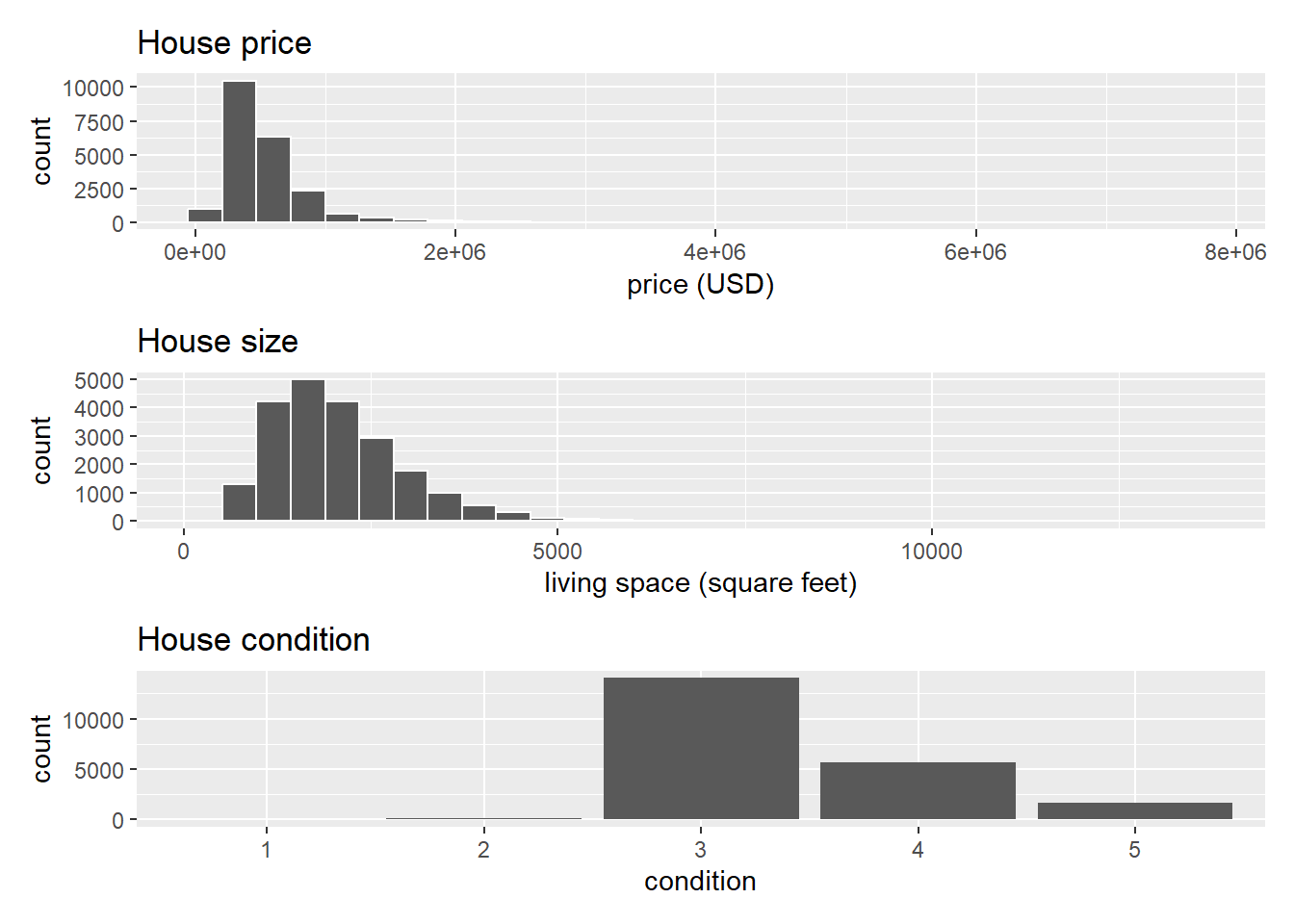
- 大多数房屋的condition为3,1和2的几乎没有。
- 大多数房屋的price低于200万美元,但也有极少数房屋的价格接近800万美元。变量price呈右偏分布,表现为长长的右尾。
- 大多数房屋的居住面积似乎不足5000平方英尺,此外该变量也呈右偏分布,尽管不像price变量那样显著。
- 针对两个变量的偏向分布情况,可以对其使用对数变换来消除。*注意,在后续进行多元回归建模时,也要使用对数变换后的变量。
# log conversion
house_prices_log <- house_prices |>
  mutate(log10_price = log10(price), log10_size = log10(sqft_living)) |>
  select(log10_price, log10_size, condition)

# multiple var plot
ggplot(
  house_prices_log,
  aes(x = log10_size, y = log10_price, col = condition)
) +
  geom_point(alpha = 0.05) +
  geom_smooth(method = "lm", se = FALSE) +
  labs(y = "log10 price", x = "log10 size", title = "House prices in Seattle")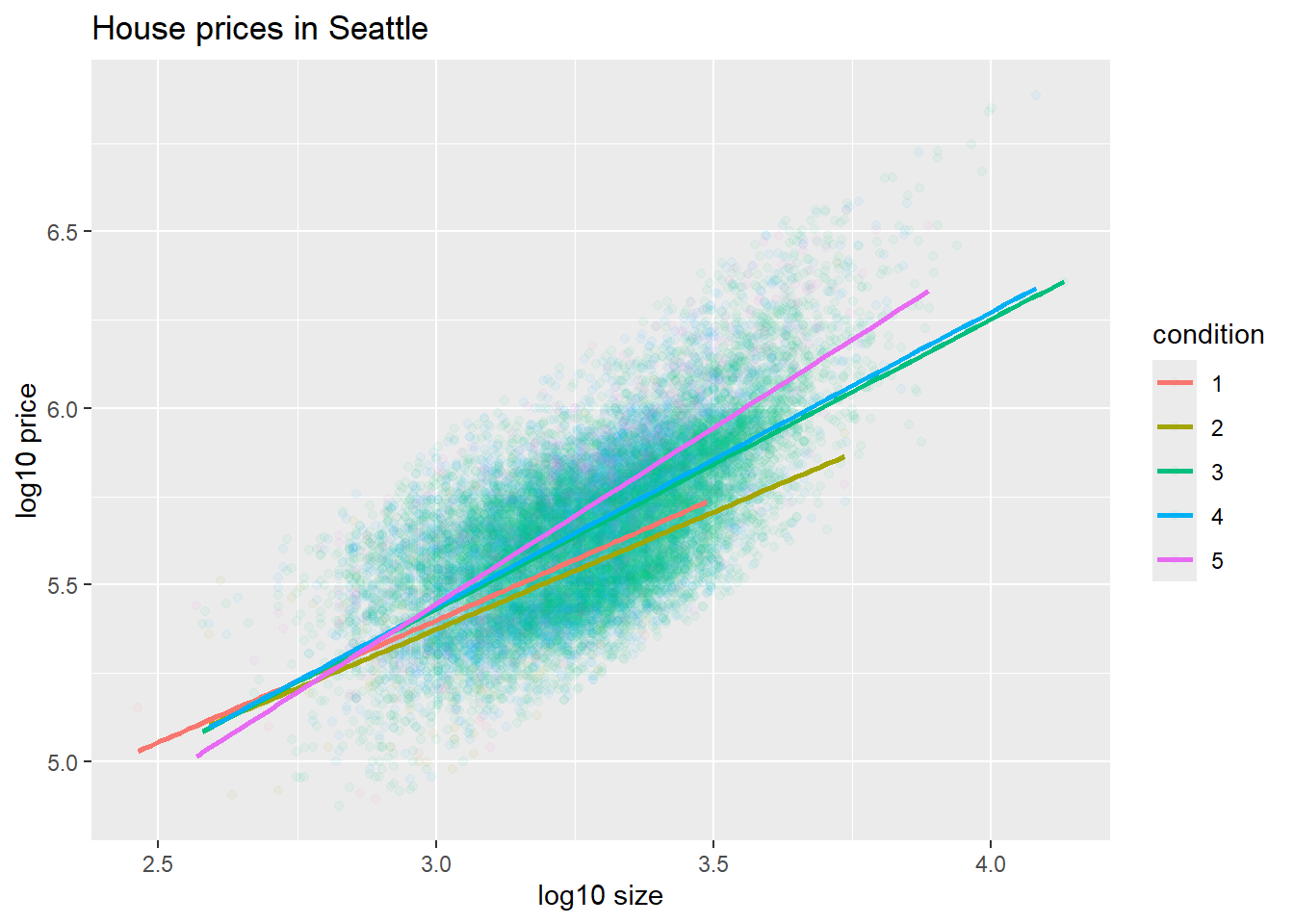
- 房价和房屋面积之间存在正相关关系,这意味着房屋面积越大,价格往往越高。
- 对于大多数房屋面积而言,状况为5的房屋似乎是最贵的。
3.1.2 回归模型建立
price_model <- lm(
  log10_price ~ log10_size * condition,
  data = house_prices_log
)
get_regression_table(price_model)
# A tibble: 10 × 7
term estimate std_error statistic p_value lower_ci upper_ci
<chr> <dbl> <dbl> <dbl> <dbl> <dbl> <dbl>
1 intercept 3.33 0.451 7.38 0 2.45 4.22
2 log10_size 0.69 0.148 4.65 0 0.399 0.98
3 condition: 2 0.047 0.498 0.094 0.925 -0.93 1.02
4 condition: 3 -0.367 0.452 -0.812 0.417 -1.25 0.519
5 condition: 4 -0.398 0.453 -0.879 0.38 -1.29 0.49
6 condition: 5 -0.883 0.457 -1.93 0.053 -1.78 0.013
7 log10_size:condition2 -0.024 0.163 -0.148 0.882 -0.344 0.295
8 log10_size:condition3 0.133 0.148 0.893 0.372 -0.158 0.424
9 log10_size:condition4 0.146 0.149 0.979 0.328 -0.146 0.437
10 log10_size:condition5 0.31 0.15 2.07 0.039 0.016 0.604根据回归结果,我们可以建立不同条件下的回归方程,并用这些方程来预测房价。要注意的是,这些方程是基于对数变换后的变量建立的,在完成预测后还需要再进行变换才能是预测的最终值。
condition = 1: \(\hat{log10(price)} = 3.33 + 0.69 \times log10(size)\)
condition = 2: \(\hat{log10(price)} = (3.33+0.407) + (0.69-0.024)\times log10(size)\)
condition = 3: \(\hat{log10(price)} = (3.33-0.367) + (0.69+1.333)\times log10(size)\)
condition = 4: \(\hat{log10(price)} = (3.33-0.398) + (0.69+0.146)\times log10(size)\)
condition = 5: \(\hat{log10(price)} = (3.33-0.024) + (0.69+0.31) \times log10(size)\)