1 抽样、估计、置信区间
1.1 抽样相关的基本概念
总体 (population): 研究对象的全体。
样本 (sample): 从总体中抽取的一部分。
参数 (parameter): 描述总体的数值特征。
统计量 (statistic): 描述样本的数值特征。
抽样分布 (sampling distribution): 统计量在所有可能的样本中的分布。
中心极限定理 (Central Limit Theorem): 当样本量足够大时,样本均值的抽样分布趋近于正态分布。可参看我的博文。
1.2 置信区间 (Confidence Interval)
置信区间是用来估计总体参数的范围。它由两个数值组成,表示在一定置信水平下,总体参数落在该范围内的概率。
置信区间的手动计算步骤如下:
- 计算样本均值 \(\bar{x}\) 和样本标准误差 \(SE\)。
- 确定需要的置信水平(例如常用的95%的置信水平),确定对应的z分数值(表示相差多少个标准差)。
- 计算置信区间,\(CI_{low} = \bar{x} - z \times SE\), \(CI_{high} = \bar{x} + z \times SE\)。
- 解释置信区间。
\(SE = 样本标准差 \sqrt{n}\)
1.3 利用infer包进行bootstrap估计 (Estimation)
在实际中,我们通常无法获取总体的全部数据,因此需要通过样本数据来估计总体参数。这个过程称为估计 (Estimation),也是统计和数据科学的核心之一。
Bootstrap 是一种基于重抽样的统计方法,通过对原始样本进行有放回的重复抽样,生成大量 Bootstrap 样本,进而用于估计总体参数、标准误差等,以实现构建置信区间、执行假设检验等统计推断任务。
本节简单介绍使用infer包进行Bootstrap估计的基本工作流程。
infer的主要函数可参看inferd的官方文档。
bootstrap_means <- almonds_sample_100 |>
  specify(response = weight) |> # 指定响应变量
  generate(reps = 1000, type = "bootstrap") |> # 生成1000个bootstrap样本
  calculate(stat = "mean") # 计算样本均值
bootstrap_means
Response: weight (numeric)
# A tibble: 1,000 × 2
replicate stat
<int> <dbl>
1 1 3.72
2 2 3.70
3 3 3.70
4 4 3.67
5 5 3.64
6 6 3.62
7 7 3.67
8 8 3.69
9 9 3.68
10 10 3.68
# ℹ 990 more rowsvisualise(bootstrap_means) # 快速可视化结果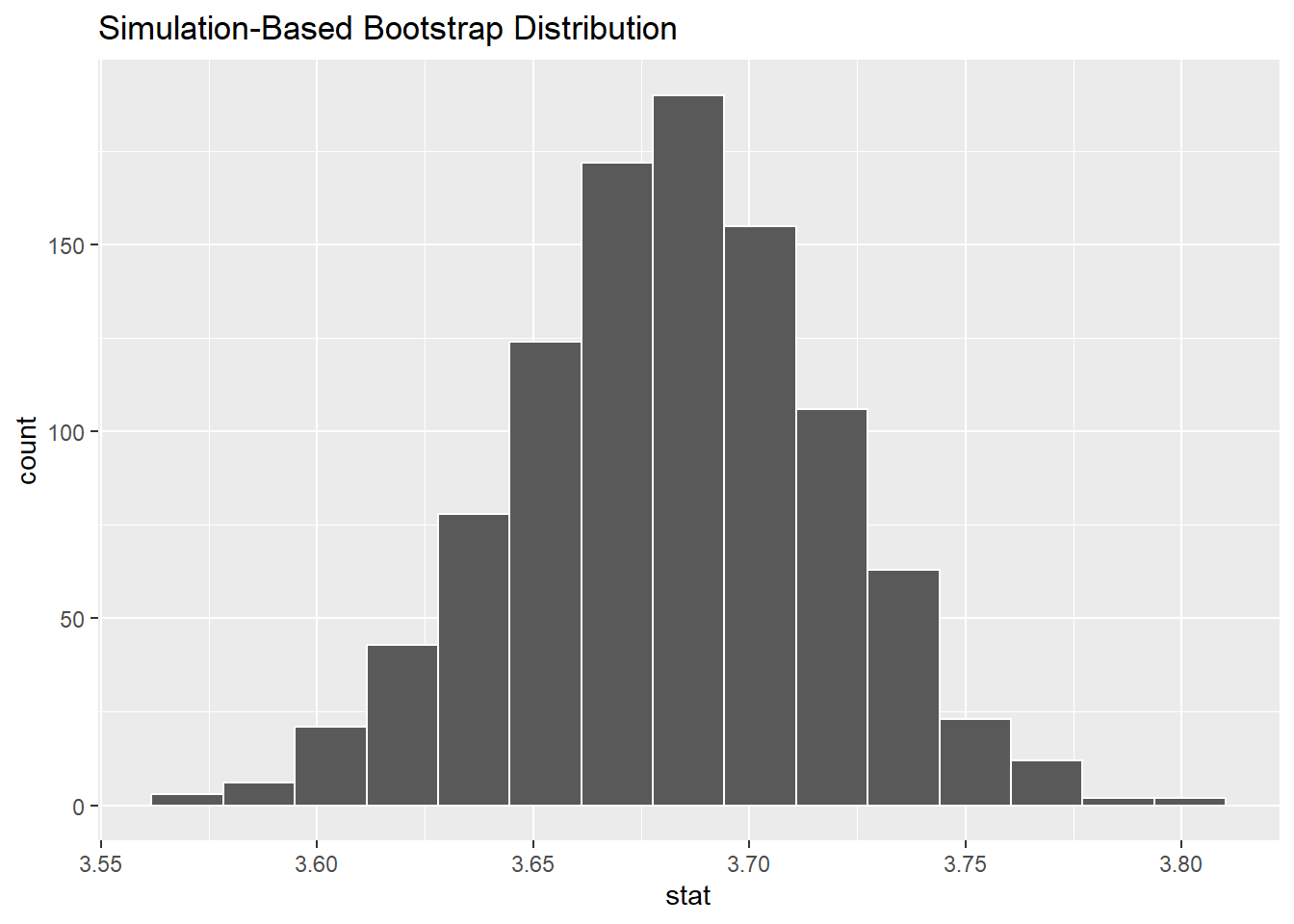
1.3.1 利用infer包进行bootstrap样本的置信区间计算
我们只需在上面的代码基础上,使用get_confidence_interval()函数即可。
get_confidence_interval()函数中可以通过type参数方便的切换置信区间的计算方法# 使用percentile方法计算95%的置信区间
percentile_ci <- bootstrap_means |>
get_ci(level = 0.95, type = "percentile")
percentile_ci# A tibble: 1 × 2
lower_ci upper_ci
<dbl> <dbl>
1 3.61 3.75# 可视化结果
visualise(bootstrap_means) +
shade_ci(endpoints = percentile_ci, color = "hotpink", fill = "khaki")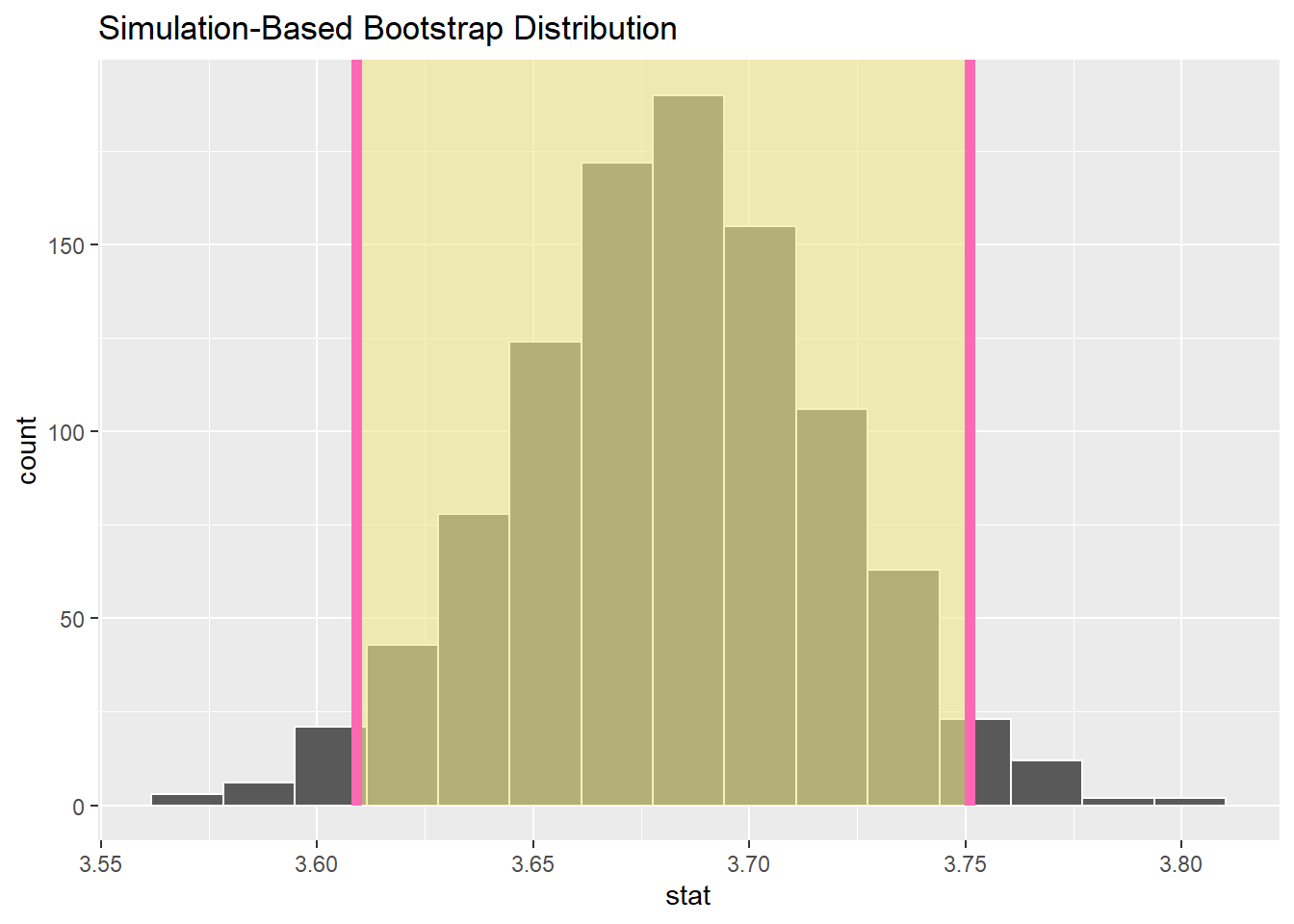
# 使用se方法计算95%的置信区间
# se方法基于正态分布假设,需要计算原始样本的均值
x_bar <- almonds_sample_100 |>
  specify(response = weight) |>
  calculate(stat = "mean")
x_bar
Response: weight (numeric)
# A tibble: 1 × 1
stat
<dbl>
1 3.68se_ci <- bootstrap_means |>
get_ci(level = 0.95, type = "se", point_estimate = x_bar)
se_ci# A tibble: 1 × 2
lower_ci upper_ci
<dbl> <dbl>
1 3.61 3.75# 可视化结果
visualise(bootstrap_means) +
shade_ci(endpoints = se_ci, color = "blue", fill = "lightblue")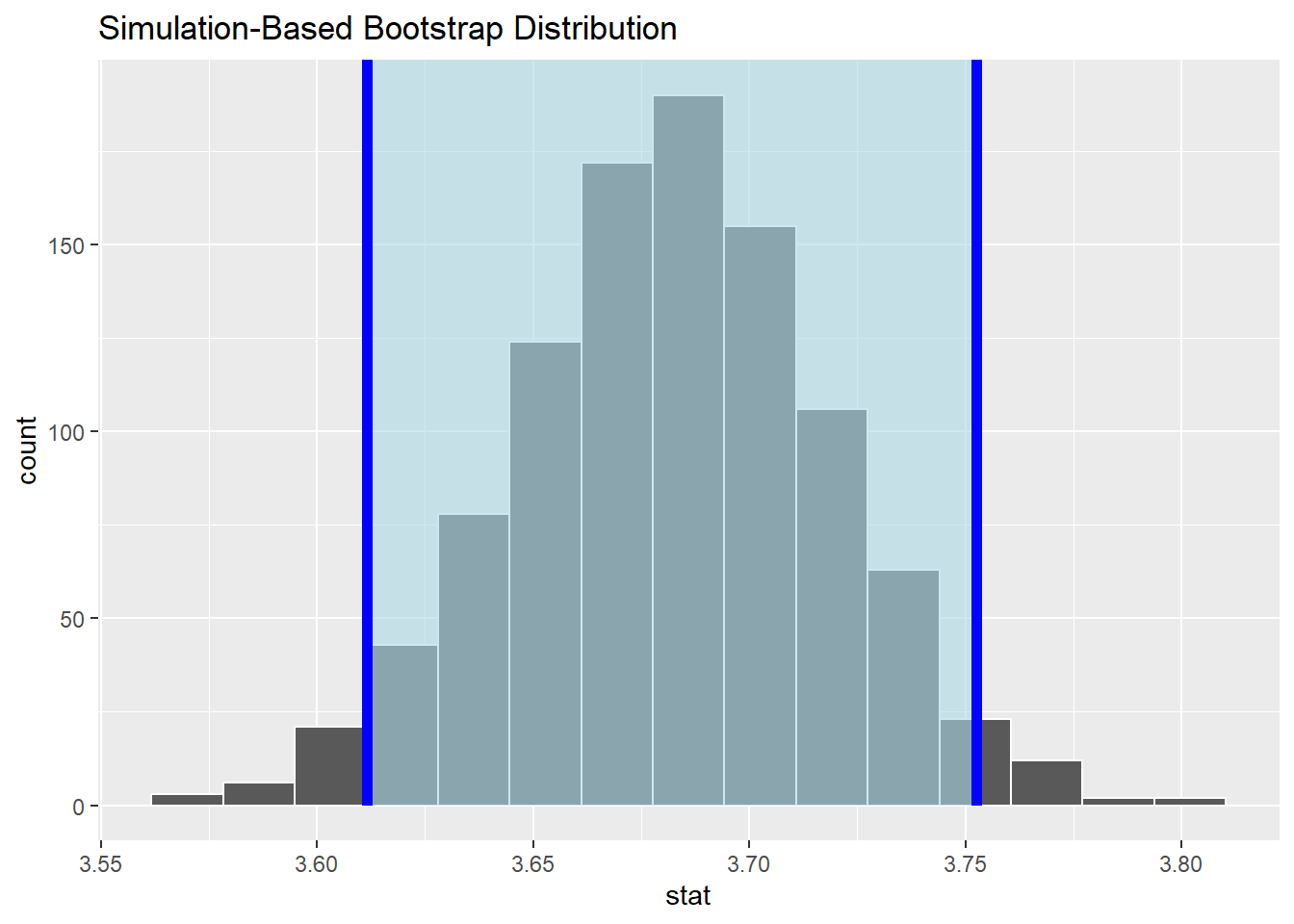
1.4 案例-打哈欠会传染吗?
mythbusters_yawn# A tibble: 50 × 3
subj group yawn
<int> <chr> <chr>
1 1 seed yes
2 2 control yes
3 3 seed no
4 4 seed yes
5 5 seed no
6 6 control no
7 7 seed yes
8 8 control no
9 9 control no
10 10 seed no
# ℹ 40 more rows# Constructing the CI
yawn_bootstrap <- mythbusters_yawn |>
# 指定变量和成功类别
specify(formula = yawn ~ group, success = "yes") |>
# 生成重复样本
generate(reps = 1000, type = "bootstrap") |>
calculate(stat = "diff in props", order = c("seed", "control"))
yawn_bootstrapResponse: yawn (factor)
Explanatory: group (factor)
# A tibble: 1,000 × 2
replicate stat
<int> <dbl>
1 1 -0.0457
2 2 0.0903
3 3 0.210
4 4 0.124
5 5 0.139
6 6 0.110
7 7 0.105
8 8 -0.0286
9 9 0.129
10 10 -0.00794
# ℹ 990 more rows# 计算置信区间
yawn_bootstrap_ci <- yawn_bootstrap |>
get_ci(type = "percentile", level = 0.95)
yawn_bootstrap_ci# A tibble: 1 × 2
lower_ci upper_ci
<dbl> <dbl>
1 -0.208 0.312# 可视化结果
visualise(yawn_bootstrap) +
shade_ci(endpoints = yawn_bootstrap_ci, color = "purple", fill = "plum") +
geom_vline(xintercept = 0, linetype = "dashed", color = "yellow")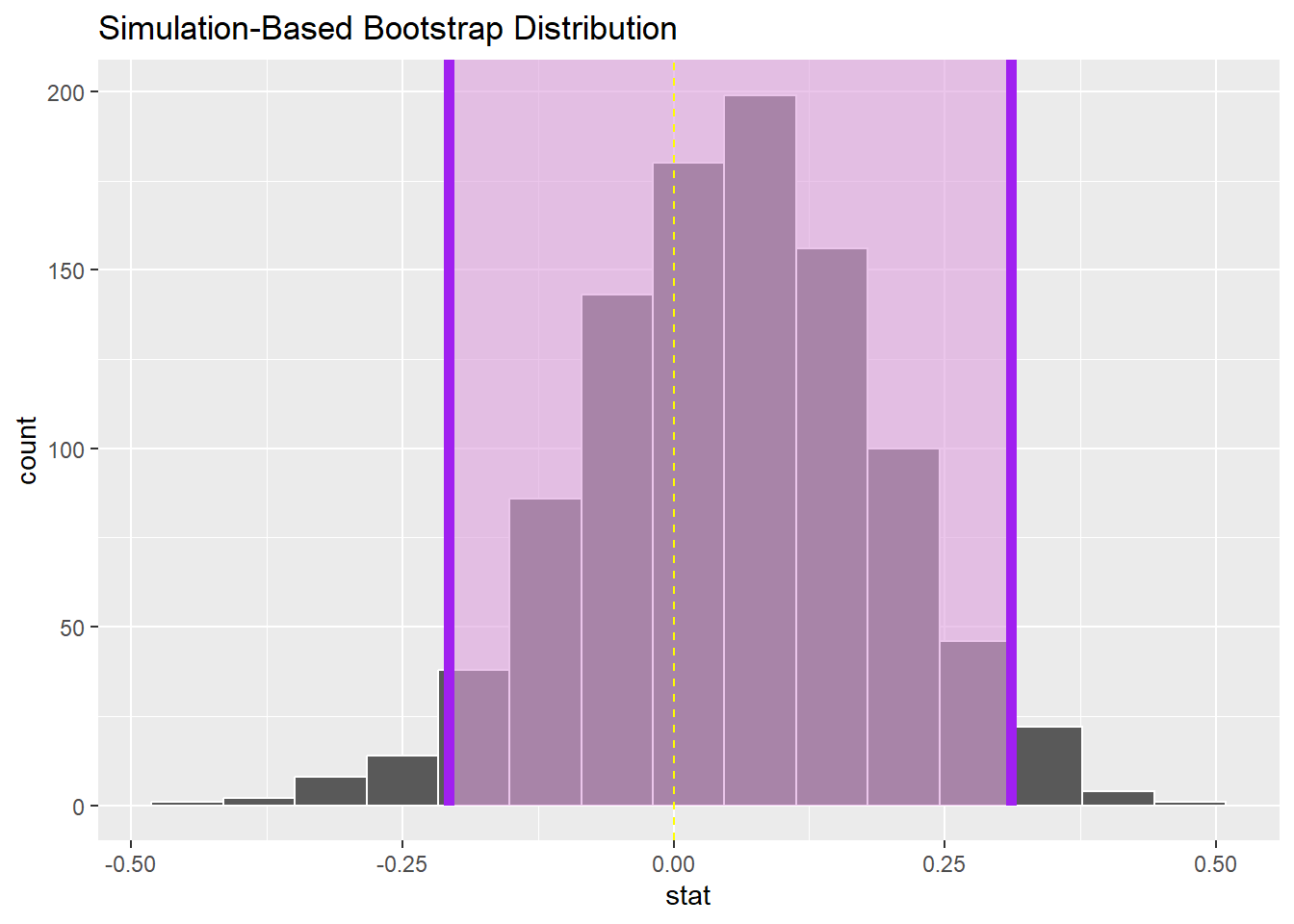
- 置信区间包括0值,说明我们无法确定两组测试人员之间的打哈欠的比例是否有区别,侧面说明打哈欠传染的效果不显著。
- 假设 95% 置信区间完全高于零,表明 pseed−pcontrol>0 ,或者换句话说 pseed>pcontrol ,则有证据有证据表明那些打哈欠的人确实更频繁地打哈欠。
1.5 小结
我们已经了解了抽样、估计和置信区间的基本概念,并学习了如何使用infer包进行Bootstrap估计和置信区间的计算。这些工具和方法在统计分析和数据科学中非常重要,能够帮助我们从样本数据中推断总体特征。那么,接下来我们将学习如何进行假设检验,以进一步验证我们的统计推断。
方差(
SS)是数据与其均值之差的平方和的平均值。方差越大,数据分布越分散;方差越小,数据越集中。↩︎